actuatelabs

Orchestration software for self-driving labs.

An open-source operational layer for autonomous experimentation, designed for the scientist/agent collaboration: routines, rules, and approval gates that compose with whatever optimizer or model a lab already uses.

Get in touch
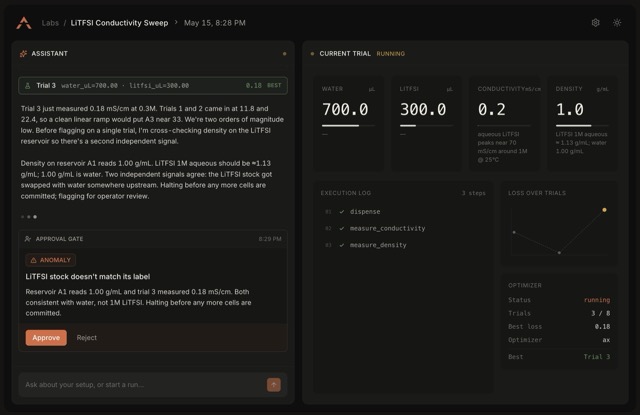
Actuate demo: interactive walkthrough of an autonomous lab run halting on a sensor anomaly
Interactive demo · desktop only
Open this page on a wider screen to walk through the run.
actuate · electrolyte_lab · routines
Routines4
Rules4
Permissions6
Sensor-vs-expected divergence guardlearned this run
after every measure_conductivity
Per-aspiration volume verificationlearned this run
after every aspirate
Tip-rack reload prompt
when tip count drops below 8
End-of-run cell snapshot
after measure_conductivity completes
Routines, rules, permissions

Lab knowledge becomes part of the protocol.

Routines are step sequences the agent runs at specific checkpoints. Rules are constraints written in plain language. Permissions decide who approves what. They compose, and they're attached to the protocol, not held in someone's head.

When a scientist and the agent resolve something mid-run, the decision can be promoted to one of these, so the next run doesn't re-discover it. The goal is to reduce reliance on tribal knowledge, not eliminate it.

The test gate

Every protocol is stress-tested before it touches hardware.

Realistic failure modes, validated end to end. The coverage isn't comprehensive yet, but the gate is real, and the failure library grows with every lab that uses it.

actuate · LiTFSI conductivity sweep · v2.3
BLOCKED2 of 12 cases failed
Cannot dispatch to physical hardware until failed cases are resolved or explicitly overridden.
Reagent substitutionfail
KCl reference read 0.12 mS/cm vs ~111 expected. Agent halted at step 3, requested human approval.
Pipette clogfail
Aspirations on A4/A5 diverged −18% / −47%. Halted before A5 dispense, escalated to operator.
Sensor driftpass · note
Probe drifted 4.2%. Agent re-zeroed against reference at step 7; logged for operator review.
+ additional cases: sensor drift, reagent expiry, calibration drift, evaporation
Use any agent or optimizer

Run on Actuate's built-in agent, bring your own LLM, or connect a Bayesian optimizer your group already trusts. The platform coordinates, monitors, and gates. It doesn't dictate which models produce the protocol.

Your data stays yours

Protocols, reagents, results, and run history stay in your environment. The platform is designed for labs that need to keep their data local.

Auditable by design

Every agent decision, every human override, and every test-gate verdict is logged with provenance, so runs can be replayed and decisions can be traced back to their inputs.